Last Judgment and New Heaven and New Earth
Paradise LostLast Judgment and New Heaven and New Earth is the final movement of the poem’s redemption history. It completes the promise made after the Fall: the Son of God, having assumed human nature, died for human sin, risen from the grave, and ascended in triumph, returns as universal King and Judge. His judgment ends the reign of sin, defeats Satan and the powers of darkness, closes Hell, and leads beyond the destruction of the present world to a renewed Heaven and Earth in which the just dwell forever.
Promise and Theological Grounding
The final renewal is prepared by the logic of substitution and restoration. The Son of God offers himself as the one able and willing to pay humanity’s mortal debt, presenting life for life and accepting death on behalf of Adam’s race. His death satisfies the penalty of disobedience, while his resurrection breaks Death’s power and makes possible the redemption of those who receive his benefit through faith joined to works. The event is therefore not an isolated catastrophe but the completion of the divine plan announced after human sin: humanity’s ruin through Adam is answered by restoration through a second root, the incarnate Son of God.
The Son’s redemptive work also determines the shape of the final judgment. Because he has humbled himself to assume human nature and has endured death for mankind, the Father exalts him as both God and man, universal King, and supreme Head. Thrones, Princedoms, Powers, and Dominions are placed under him; every knee in Heaven, Earth, and Hell must bow. His humiliation becomes the ground of his authority, so the final tribunal is simultaneously an act of justice and the public vindication of obedient love.
The Return and Universal Judgment
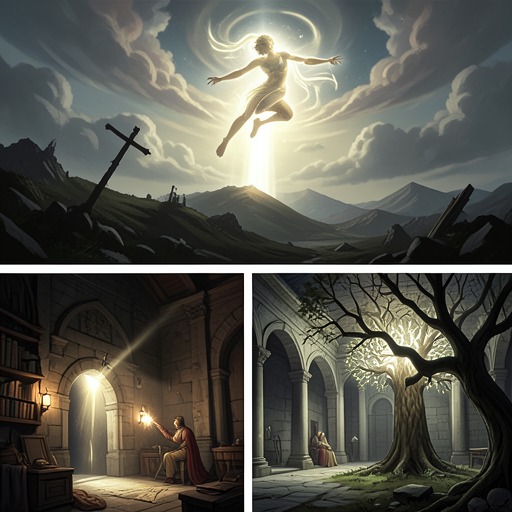
The Son of God will return from Heaven with glory and power when the dissolution of the world is ripe. The return is visible and sovereign: he appears in the clouds in the glory of the Father and sends the Archangels to proclaim his tribunal. The living are summoned from every wind, and the dead of all past ages are called from their sleep to the general Doom. The scale of the scene is universal, extending across every generation and every region of the created order rather than being confined to one nation or one historical moment.
At the tribunal, the Son judges both bad men and bad Angels. The unfaithful sink beneath his sentence, while the faithful are received into bliss. Judgment thus separates two futures that have been interwoven throughout history: the future of those who accept grace and remain faithful, and the future of those who reject it, corrupt truth, or persist in opposition to God. Hell, once filled with the condemned, is thereafter shut forever, transforming punishment from an ongoing sphere of rebellion into a closed and final judgment.
Defeat of Satan and the End of Corruption
The judgment also concludes the long conflict initiated by Satan’s rebellion and extended through human history. Satan’s fall from Heaven did not immediately destroy his capacity to injure Adam’s descendants; his works continued through temptation, sin, false worship, violence, and the corruption of religious and political power. The promised Savior therefore defeats Satan not merely by annihilating him in direct combat, but by destroying the works through which Satan has wounded humanity.
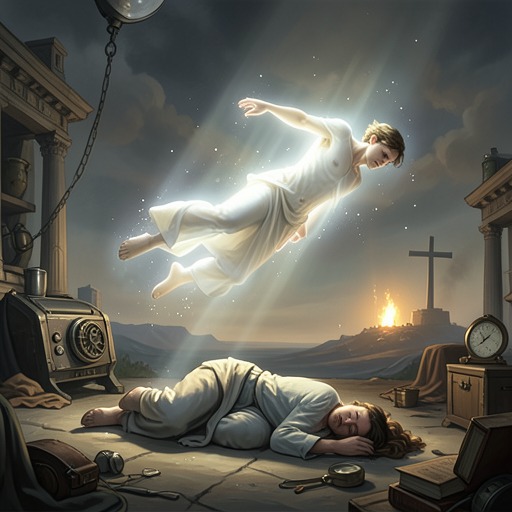
The Son’s death and resurrection are the decisive reversal. By dying under the penalty owed by mankind and rising before Death can retain him, he crushes Sin and Death, described as the two principal arms of Satan. At his ascension he triumphs through the air, chains the Serpent, Prince of the air, and leaves him confounded throughout his realm. At the final return, the Son dissolves Satan together with his perverted world. The enemy’s apparent victory over humanity is thus reversed at its source: the power that entered through disobedience is overcome by obedience, sacrificial love, and resurrection life.
The historical interval before the end is marked by a further corruption of the faith. After the Apostles have preached to all nations, received spiritual gifts, and left their doctrine and story in written records, later teachers turn sacred mysteries toward lucre and ambition. They mingle truth with superstition and tradition, join spiritual claims to secular power, and impose carnal laws upon conscience. Persecution follows against those who continue to worship in spirit and truth, while outward rites are mistaken for sufficient religion. The final judgment exposes and ends this inversion, bringing vengeance to the wicked and relief to the just.
Destruction and Renewal of Creation
The existing world is not simply abandoned; it is burned, purged, and remade. At the appointed consummation, the world dissolves in conflagration, and from its ashes arise new Heaven and new Earth. The imagery turns destruction into purification: the old creation, disordered by sin, is refined so that the renewed order can be founded in righteousness, peace, and love rather than violence, corruption, and death.
This renewed Earth is more blessed than Eden. The first Paradise represented humanity’s original innocence, but the final world embodies restoration after judgment and redemption. Its inhabitants are the just, who have passed through long tribulation and now enter golden days fruitful of golden deeds. Joy and Love triumph, Truth is fair and secure, and the Earth itself becomes Paradise. The contrast with the fallen world is therefore both spatial and moral: the new creation is not merely repaired scenery but a transformed order in which the consequences of sin no longer govern existence.
The renewal also completes the movement from created hierarchy to perfect divine sovereignty. After the Son has reigned as universal King and brought all enemies beneath his judgment, he lays aside the regal scepter because a scepter is no longer needed. God becomes All in All. Political dominion, punitive rule, and the instruments of conflict reach their proper end in a creation whose harmony rests directly in divine presence.
Significance in the Redemptive History
The event resolves the poem’s central opposition between death and life. Adam’s transgression introduces guilt, mortality, and disorder; the Son’s incarnation, death, and resurrection answer them with atonement, renewed life, and final reconciliation. The pattern is repeatedly announced through prophecy: the Woman’s Seed will suffer, defeat the Serpent’s work, rise from death, gather believers from every nation, ascend to Heaven, and return to judge the world. Last Judgment and New Heaven and New Earth gathers these separate promises into one consummating action.
For Adam, the vision changes the meaning of the Fall. He first sees human violence in the murder of Abel and learns that death takes many forms; he then hears that the Redeemer’s death will be unlike ordinary death, because it will lead through the grave to immortal life. The final renewal allows him to understand how good can come from evil and how grace can exceed wrath. His recognition is not permission to value sin, but an acknowledgment that divine wisdom can transform the consequences of sin into the occasion for greater mercy and glory.
The final lesson is therefore ethical as well as eschatological. Adam learns that obedience is best, that love joined with reverent fear should govern human conduct, and that faith must be accompanied by virtue, patience, temperance, and charity. Death for the faithful becomes the gate of life rather than the termination of hope. The new creation makes visible the inward paradise that Adam is instructed to possess: restoration begins in faithful understanding and reaches its full form when the renewed Heaven and Earth are founded in righteousness, peace, and love.